 apolloai.cloud
Apollo A.I. · Recorder · tester build
Do a task once. The system writes the automation.
It watches you do the task in your browser or on your desktop, writes the automation, checks it, and runs it when you say so. Written by Apollo’s own model, on Apollo’s own hardware.
Current build
AVS Recorder 0.3.1
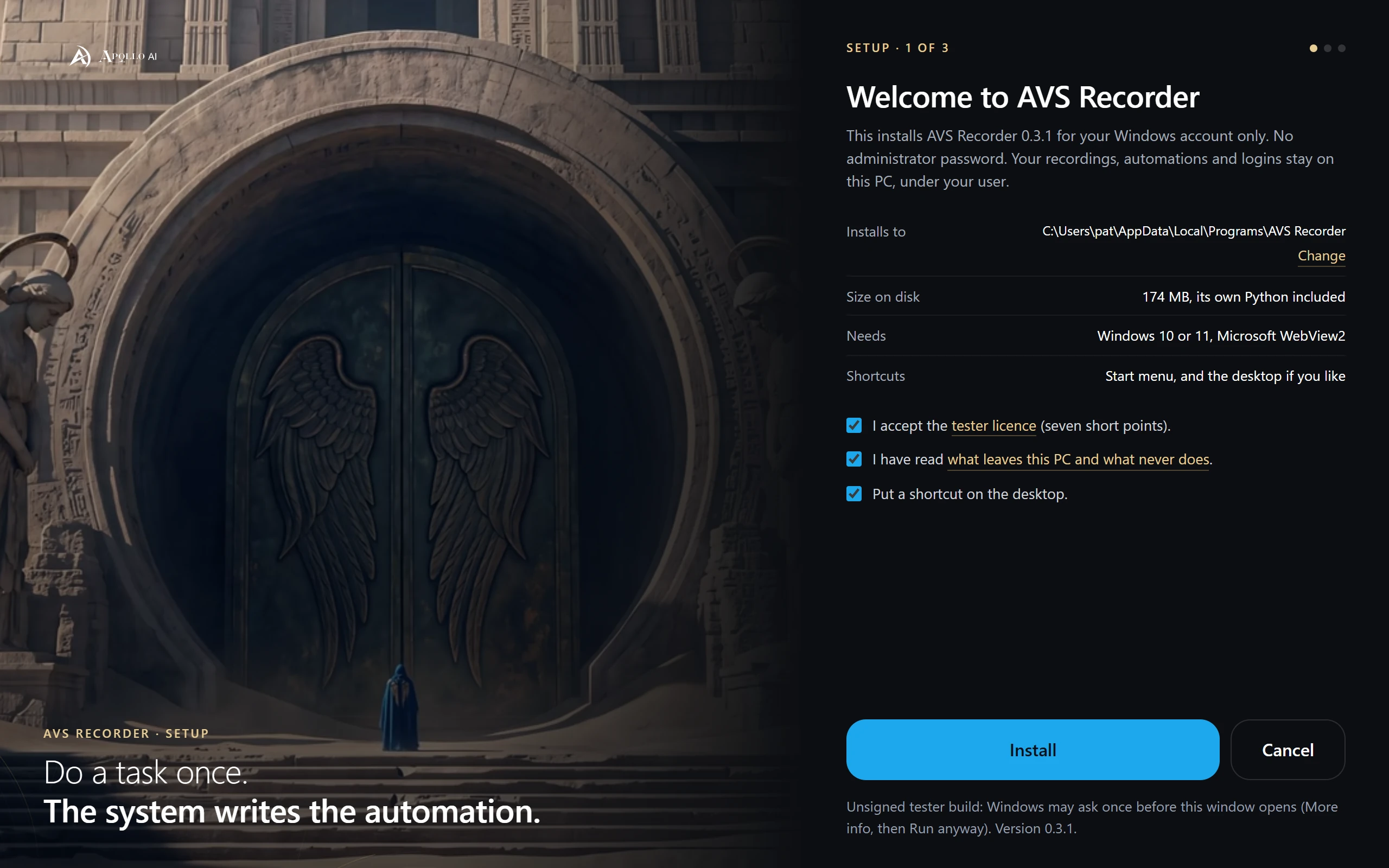
Download the RecorderThe first time, Windows may show a blue box because the build is not code-signed yet: More info, then Run anyway. It asks once. No administrator password.
- Edge or Chrome
- Your invitation’s access code
- Installs for your account only
How it compares · measured 27 October 2026
Apollo Model 1.0.1 drafts closest to the reference: 0.91. 26 points ahead of the best Claude model on the same 100 tasks.
Step match, from 0 to 1, is how closely a draft follows the reference automation, step by step, on 100 held-out tasks from public web-automation sets. Every model got the same instructions, the same example and one correction pass. A step the reference does not have counts against a draft, including the checks the Claude models add; drafts were compared as written, not run.
All six models reproduced nearly all of the recorded actions (0.90 to 0.98). The difference is what a draft adds that the reference does not have. Apollo Model 1.0.1 and its base ran in their 8-bit builds on a rented GPU, at temperature zero, with the output held to the Recorder’s schema; the Claude models ran through their public API at medium effort, without the schema. The build that serves testers is compressed further; measured once on 40 of these tasks it scored 0.85, with 0.95 on the 36 drafts it returned.
| Model | Step match | |
|---|---|---|
| Apollo Model 1.0.1, 100 tasks, 8-bit build on a rented GPU | 0.91 | |
| The same model before training, 100 tasks, the same build without Apollo’s training, 6 drafts that failed validation count as 0 | 0.65 | |
| Claude Haiku 5.5, 100 tasks, public API, medium effort, 5 drafts cut off at the token cap count as 0 | 0.65 | |
| Claude Sonnet 5.5, 100 tasks, public API, medium effort | 0.64 | |
| Claude Opus 5.5, 100 tasks, public API, medium effort, two runs on the same day, 87 and 13 tasks | 0.62 | |
| On the first 40 of those tasks by name, the 40 that Claude Fable 5.1 ran | ||
| Apollo Model 1.0.1, the same 40 tasks, 8-bit build on a rented GPU | 0.95 | |
| Claude Fable 5.1, 40 of the 100 tasks, public API, medium effort, the other Claude models scored 0.57 to 0.58 on these 40 | 0.62 | |
- 99 of 100Tasks on which its draft was at least as close to the reference as the best draft from any of the Claude models. Never below the same model before training: closer on 87 tasks, level on 13.
- 45 of 100Drafts identical to the reference, step for step. 8 of 100 before training.
- 0.92Precision: 92 in 100 of the steps it writes are in the reference. 72 in 100 before training.
- 16,476Examples in the first training. The next trainings come from your own approved runs: the model learns your tasks, on your schedule, and the score is checked before a new version ships.
The Recorder, screen by screen
Record once. It writes and checks. You approve and run.


Captured from AVS Recorder 0.3.1 · 7 November 2026 · a demonstration account; the automations were recorded on public practice sites
The tester guide, one page
Nine steps, start to finish.
- 01 · InstallRun the installerThe licence and the privacy statement, then Install. It starts by itself.
- 02 · Sign inPaste your access codeFrom the invitation e-mail. It stays on your PC, encrypted for your Windows account.
- 03 · First runFour short cardsName the PC, connect the mailbox for sign-in codes, pick the browser, try the practice site.
- 04 · RecordDo the task oncePress Record, do it in the browser the Recorder opens, press Stop.
- 05 · WriteThe model drafts itAudited, rehearsed and dry-run before you see it; every step in words.
- 06 · ApproveRead, then approveApprove runs it for real; the browser stays visible while it works.
- 07 · FixWhen a run stopsWhich step, which page, a picture. Tell it what went wrong, or ask a stronger model.
- 08 · Your filesWhere things liveUnder your Windows user in the Apollo AI folder; downloads in your Downloads folder.
- 09 · HelpReport a problemSettings > Help & support, or Report this problem on a stopped run.
What leaves your PC
The values you type, your passwords and codes, your screenshots and your files never leave your PC. To write an automation the Recorder sends the shape of what you recorded: control labels, page paths, the kind of each value. The full statement is in the program under Settings > Privacy.
Questions
Write to support@avs.business, or use Help & support inside the program. A tester account comes with trial credits for the stronger cloud model; the Apollo Node answers at no cost. A cloud draft is used only when the local one is stuck, and only if you switch that on. In the 27 October measurement a short recording cost about five cents with Claude Opus 5.5 at list price; a long one costs more, and the button names the credits before you use it.